
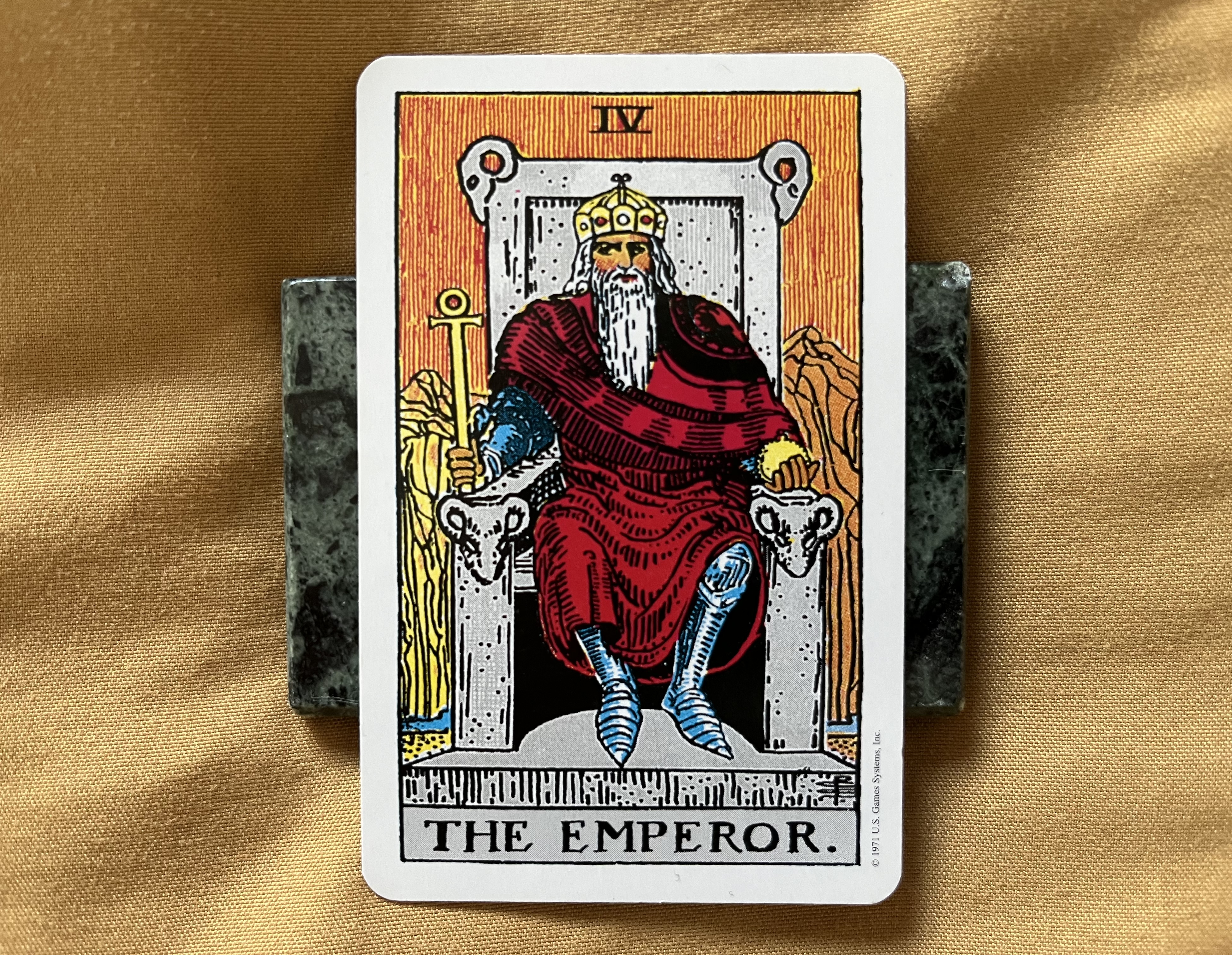
Dopo l’Imperatore, che stabilisce le fondamenta della realtà attraverso la legge e la struttura, l’energia dell’Arcano V si innalza verso la dimensione dello spirito. Il Papa — o Ierofante — rappresenta l’autorità spirituale, il tramite fra il divino e l’umano, il custode di una saggezza antica che si trasmette per via iniziatica. Non è un potere che si impone con la forza, ma una guida che si afferma attraverso l’ascolto, la conoscenza e il sacro.
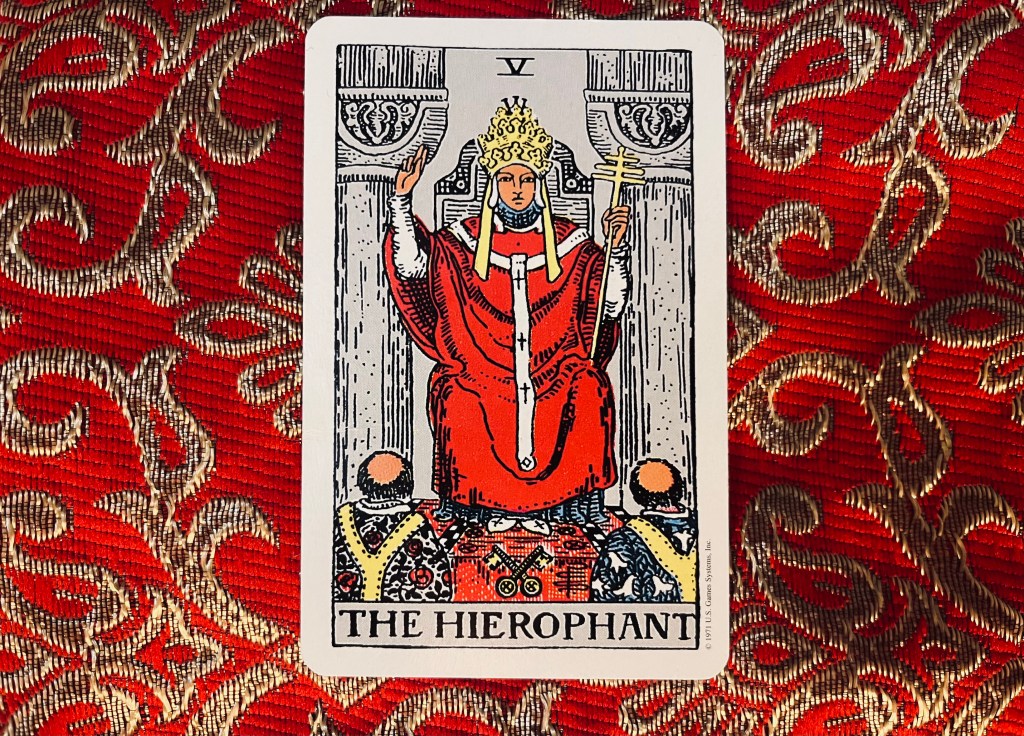
Nelle rappresentazioni tradizionali dei Tarocchi — come nel mazzo di Marsiglia o nel Rider-Waite — il Papa è raffigurato come un uomo anziano, solenne, assiso tra due colonne che richiamano quelle del Tempio di Salomone: esse rappresentano i poli complementari, la porta d’accesso a un sapere superiore. Indossa la tiara papale a tre corone, simbolo del dominio su corpo, anima e spirito. Nella mano sinistra impugna lo scettro a tripla croce, emblema della sua autorità spirituale; con la destra benedice, estendendo il potere del verbo e della tradizione. Ai suoi piedi, due discepoli — spesso tonsurati — lo ascoltano in atteggiamento reverente: sono gli iniziati, i portatori della conoscenza che il Papa custodisce e trasmette.
Il numero cinque che accompagna questo arcano è un numero dinamico, ponte tra la stabilità del quattro e la tensione verso l’ignoto del sei. È il numero dell’uomo nella sua forma completa (cinque dita, cinque sensi), ma anche della prova, dell’apprendimento, dell’evoluzione spirituale attraverso la disciplina. Il Papa, in questo senso, non è solo una figura esterna, ma un archetipo interno che ci invita a trovare la nostra guida interiore, a mettere ordine nelle nostre credenze, a connetterci con un significato più ampio.
Il Papa è l’archetipo del Maestro, e il suo compito è trasmettere. A differenza della Papessa, che custodisce il sapere in silenzio, il Papa lo esprime, lo articola, lo rende accessibile. È la parola incarnata, la tradizione orale, il rito che consacra, il verbo che ordina e consacra. Ma attenzione: la sua parola non è mai improvvisata. È meditata, rituale, precisa. Ogni gesto, ogni insegnamento, ha un valore archetipico.
A livello mitologico, possiamo trovare analogie nel greco Chirone, il centauro saggio, guaritore e maestro di eroi, oppure in Ermes/Mercurio, messaggero tra il mondo degli dei e quello degli uomini. Ma anche figure bibliche come Mosè, che riceve e trasmette la Legge, o Elia, profeta che parla a nome del divino. In Oriente, ricorda il maestro zen o il guru vedico, colui che guida senza costringere, che mostra la via attraverso l’esperienza e la presenza.
Dal punto di vista simbolico, il Papa è il custode delle chiavi del cielo, come spesso raffigurato nella tradizione cristiana. Una chiave d’oro e una d’argento — simboli dell’accesso al visibile e all’invisibile, al sapere terreno e a quello spirituale. Egli è il pontefice nel senso letterale del termine: colui che costruisce ponti tra mondi, tra il sacro e il profano, tra l’alto e il basso.
Quando questa carta appare in una lettura, può indicare la necessità di cercare una guida o diventare una guida per gli altri. È un invito a seguire una vocazione spirituale o morale, ad approfondire la propria fede, a interrogarsi sulle tradizioni che ci abitano e ci strutturano. In ambito affettivo, può suggerire un’unione sancita da valori profondi o da un legame spirituale. Nel lavoro, può indicare il ruolo di mentore, l’insegnamento, la formazione o la necessità di attenersi a un’etica solida. A livello personale, il Papa ci guida a esplorare le nostre credenze, a distinguere tra dogma e intuizione, tra ciò che ci è stato insegnato e ciò che abbiamo davvero interiorizzato.
Se il Papa si presenta capovolto, la sua energia si distorce: può diventare autoritarismo spirituale, fede cieca, dogmatismo. Può anche indicare confusione morale, perdita di direzione, oppure la ribellione a schemi troppo rigidi. In certi casi, invita a rompere con una tradizione ormai sterile, per riscoprire una connessione diretta e autentica con il divino.
In un mondo frenetico e spesso smarrito, il Papa ci ricorda il valore del tempo, della riflessione, della profondità. Ci invita a ritrovare la nostra bussola interiore, a costruire ponti tra ciò che sappiamo e ciò che crediamo. È l’archetipo del maestro che insegna col cuore, del rito che dà senso all’azione, della parola che guarisce e guida. In lui, la spiritualità si fa presenza, e la conoscenza si fa vita.
The Hierophant in the Tarot: the bridge between heaven and earth.
After the Emperor, who establishes the foundations of reality through law and structure, the energy of the Fifth Arcana rises toward the realm of spirit. The Hierophant — or Pope — represents spiritual authority, the intermediary between the divine and the human, the guardian of an ancient wisdom passed down through initiation. His power does not impose through force but leads through listening, knowledge, and the sacred.
In traditional depictions of the Tarot — such as in the Marseille deck or the Rider-Waite — the Hierophant is shown as an elderly, solemn man, seated between two columns reminiscent of the Temple of Solomon: symbols of duality and the gateway to higher understanding. He wears a papal tiara with three crowns, representing dominion over body, soul, and spirit. In his left hand, he holds a scepter with a triple cross, emblem of his spiritual authority; with his right, he gives a blessing — extending the power of the word and of tradition. At his feet, two acolytes — often tonsured — kneel in reverence: they are the initiates, the carriers of the knowledge the Hierophant protects and transmits.
The number five, which marks this arcana, is dynamic — a bridge between the stability of four and the unfolding of six. It is the number of humanity in its full form (five fingers, five senses), but also of challenge, learning, and spiritual evolution through discipline. The Hierophant, in this sense, is not only an external figure but an inner archetype that invites us to find our inner guide, to give structure to our beliefs, to connect with a deeper meaning.
He is the archetype of the Master Teacher, whose mission is to transmit. Unlike the High Priestess, who guards knowledge in silence, the Hierophant expresses it, articulates it, makes it accessible. He is the embodied word, the oral tradition, the ritual that consecrates, the voice that blesses and orders. His speech is never improvised — it is deliberate, ceremonial, precise. Every gesture, every teaching, carries archetypal value.
In mythology, we might compare him to Chiron, the wise centaur and healer of heroes, or to Hermes/Mercury, the messenger between gods and men. In biblical traditions, he echoes Moses, who receives and transmits the Law, or Elijah, the prophet who speaks for the divine. In Eastern traditions, he resembles the Zen master or the Vedic guru — the one who guides without coercion, who leads through presence and insight.
Symbolically, the Hierophant is the keeper of the keys to heaven, as often depicted in Christian iconography — one golden, one silver — representing access to both the seen and the unseen, to earthly knowledge and divine wisdom. He is a pontifex, literally a “bridge-builder” — linking the sacred and the profane, the high and the low, the temporal and the eternal.
When this card appears in a reading, it may suggest the need to seek a mentor — or to become one. It is a call to follow a spiritual or ethical vocation, to deepen faith, to question the beliefs that shape us. In love, it may point to a bond anchored in shared values or a spiritual connection. In work, it can indicate a teaching role, mentorship, ethical leadership, or the importance of following a tradition. On a personal level, the Hierophant urges us to reflect on what we truly believe, to separate inherited dogma from inner truth.
When reversed, the Hierophant’s energy distorts: it can become authoritarianism, blind faith, or rigid dogmatism. It may indicate moral confusion, loss of direction, or rebellion against outdated systems. Sometimes, it signals the need to break away from dead traditions and reconnect with a living, direct experience of the sacred.
In a world marked by speed and uncertainty, the Hierophant reminds us of the value of time, depth, and reflection. He invites us to rediscover our inner compass, to build bridges between what we know and what we believe. He is the archetype of the teacher who leads with heart, of the ritual that gives meaning, of the word that heals and guides. In him, spirituality becomes presence, and knowledge becomes life.
ARTICLE & TRANSLATION
Antonella Buttazzo
@antonella_buttazzo
 Pigiama Magazine ☾
1 Comment