
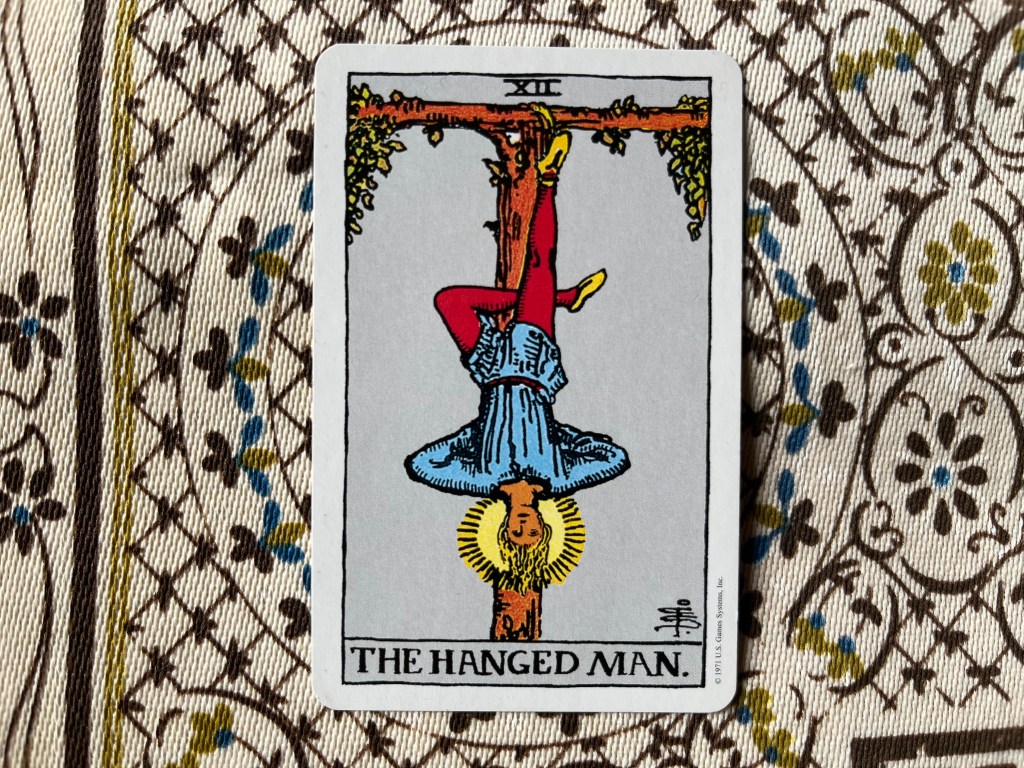
Il dodicesimo Arcano dei Tarocchi, L’Appeso, è un enigma sospeso a metà tra immobilità e rivelazione. Lo vediamo nel mazzo Rider–Waite appeso a testa in giù, con un piede legato a un ramo a forma di T, l’altro piegato in un gesto armonioso, quasi una danza lenta. Il suo volto è calmo, illuminato da un’aureola dorata: non c’è traccia di dolore, piuttosto la pace di chi ha accettato una condizione scelta. L’Appeso non è un condannato: è un viaggiatore interiore che ha accettato di fermarsi per vedere il mondo da un’angolazione nuova, rinunciando alla corsa per ascoltare il battito silenzioso delle cose.
Questa figura ci parla di una forza che nasce dal capovolgimento. In una società che misura il valore sull’azione e sulla velocità, l’Appeso rappresenta l’elogio della sosta e della resa consapevole. La sua immobilità non è inazione: è concentrazione, è gestazione di senso. Sospeso tra terra e cielo, egli trasforma la condizione di attesa in uno spazio sacro, dove il tempo si dilata e la comprensione matura.
Il numero XII, che lo identifica, è simbolo di passaggio e di sintesi: il ciclo di completamento (10) e la dualità (2) si uniscono, suggerendo un equilibrio precario ma necessario. Dopo la Giustizia (XI), che ordina e giudica, l’Appeso scioglie i nodi dell’ego e accetta di non controllare tutto. È la resa prima della metamorfosi, il respiro trattenuto prima del balzo che porterà alla Morte (XIII) e alla rinascita.
L’Appeso risuona con antichi archetipi di sacrificio e illuminazione: il dio Odino, che si appese a Yggdrasil per nove giorni e notti, rinunciando alla propria vista ordinaria per acquisire la conoscenza delle rune; il Cristo crocifisso, che trasforma la sofferenza in atto redentore; Prometeo, che affronta la catena per portare il fuoco agli uomini. Ma in questo arcano il sacrificio non è imposto dall’esterno: è la scelta volontaria di rinunciare a un cammino lineare per accogliere una comprensione più alta.
Sul piano psicologico, L’Appeso rappresenta il momento in cui, per avanzare, occorre fermarsi. È l’atto di abbandonare un’urgenza o una volontà di controllo per osservare le cose da un’angolazione rovesciata. È anche l’invito a sospendere il giudizio, a rinunciare a risposte immediate, a tollerare l’incertezza come terreno fertile di intuizioni. In amore, può parlare di legami che richiedono pazienza e introspezione; nel lavoro, di un momento di stallo necessario per riorientare il progetto; nella spiritualità, dell’accettazione come via verso la saggezza.
Quando appare diritto in una lettura, annuncia che il tempo dell’azione diretta non è ancora arrivato: bisogna osservare, attendere, lasciare che le forze maturino. È un invito alla fiducia, alla consapevolezza che la quiete può essere più potente del movimento cieco.
Se invece L’Appeso appare invertito, il messaggio si oscura: la pausa diventa immobilismo sterile, la rinuncia si trasforma in fuga dalle responsabilità, il sacrificio si svuota di senso. Può indicare che ci si sta trattenendo per paura, o che ci si sacrifica per qualcosa che non porta frutto.
L’Appeso insegna che ci sono strade che si aprono solo quando smettiamo di camminare, e visioni che si rivelano solo a chi accetta di guardare il mondo al contrario. La sua è la lezione della resa attiva: fermarsi non per arrendersi alla fine, ma per prepararsi a un inizio diverso, più lucido, più vero.
The Hanged Man in the Tarot: Surrender to another vision
The twelfth Major Arcana, The Hanged Man, is an enigma suspended between stillness and revelation. In the Rider–Waite deck, we see him hanging upside down, one foot bound to a T-shaped branch, the other bent in a graceful, almost dance-like posture. His face is serene, crowned with a golden halo: there is no sign of suffering, but rather the peace of one who has embraced a chosen condition. The Hanged Man is no condemned soul—he is an inner traveler who has willingly stopped to see the world from a new angle, forsaking the race in order to hear the silent heartbeat of things.
This figure speaks of a strength born of reversal. In a society that measures worth through action and speed, The Hanged Man is an ode to pause and conscious surrender. His stillness is not inaction—it is concentration, the gestation of meaning. Suspended between earth and sky, he transforms the condition of waiting into a sacred space where time expands and understanding ripens.
The number XII, which identifies him, is a symbol of passage and synthesis: the cycle of completion (10) united with duality (2), suggesting a precarious yet necessary balance. After Justice (XI), which orders and judges, The Hanged Man loosens the knots of the ego and accepts the truth that not everything can be controlled. He is the surrender before metamorphosis, the held breath before the leap that leads to Death (XIII) and to rebirth.
The Hanged Man resonates with ancient archetypes of sacrifice and illumination: the god Odin, who hung himself on Yggdrasil for nine days and nights, relinquishing ordinary sight to gain the knowledge of the runes; Christ on the cross, who transforms suffering into a redemptive act; Prometheus, who endured his chains to bring fire to humankind. Yet in this Arcana, sacrifice is not imposed from without—it is the voluntary choice to step away from a linear path in order to embrace a higher understanding.
On the psychological plane, The Hanged Man represents the moment when, in order to advance, one must first stop. It is the act of relinquishing urgency or the desire for control to see things from a reversed perspective. It is also an invitation to suspend judgment, to resist the lure of immediate answers, and to tolerate uncertainty as fertile ground for insight. In love, it may speak of bonds requiring patience and introspection; in work, of a pause necessary to redirect a project; in spirituality, of acceptance as a path to wisdom.
When upright in a reading, it signals that the time for direct action has not yet arrived: one must watch, wait, and allow forces to mature. It is an invitation to trust, to recognize that quiet may be more powerful than blind motion.
When reversed, however, the message darkens: pause becomes sterile stagnation, surrender turns into evasion of responsibility, and sacrifice loses its meaning. It may indicate that fear is holding one back, or that one is giving too much for something that bears no fruit.
The Hanged Man teaches that there are paths which open only when we stop walking, and visions that reveal themselves only to those willing to see the world upside down. His is the lesson of active surrender: stopping not to concede the end, but to prepare for a different beginning—clearer, truer, and more alive.
 Pigiama Magazine ☾