
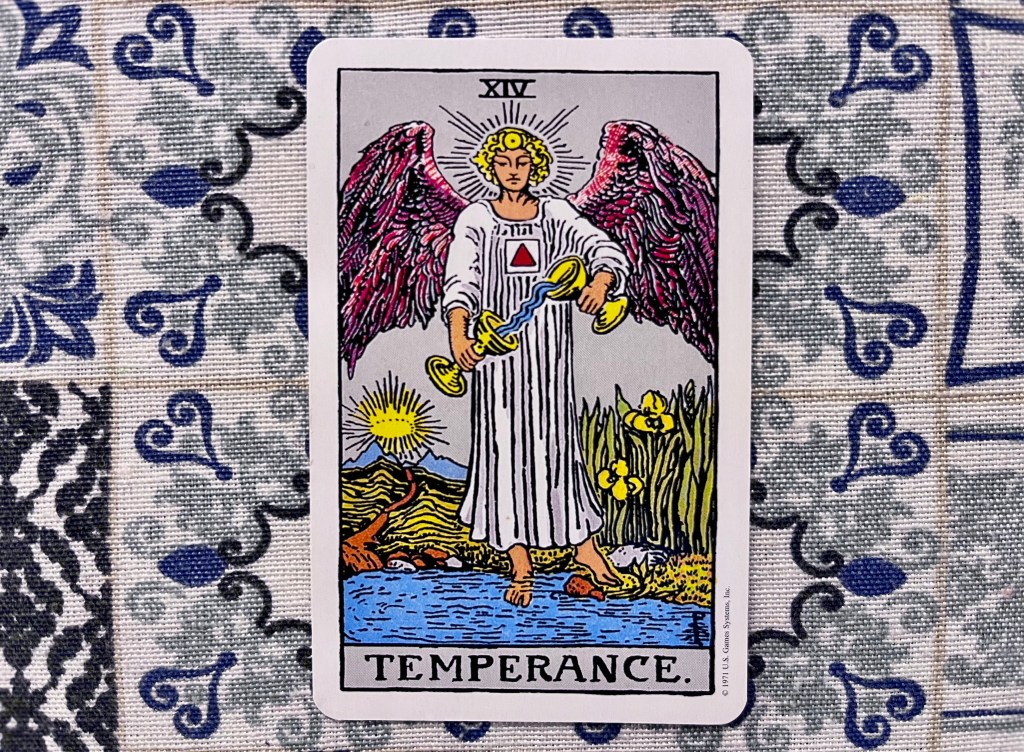
Il quattordicesimo Arcano dei Tarocchi, nella tradizione Rider–Waite, si manifesta come un angelo dalle ali dorate che versa acqua da una coppa all’altra in un flusso che sfida la logica della fisica e obbedisce invece a quella del simbolo.
Un piede poggia saldo sulla terra, l’altro sfiora la superficie dell’acqua: due mondi, due elementi, due nature che si incontrano senza confondersi. Sul petto, un triangolo inscritto in un cerchio racconta l’unione perfetta tra spirito e materia, fra ciò che è eterno e ciò che muta. Sullo sfondo, una strada dorata si allunga verso montagne azzurre: promessa di un cammino che conduce oltre l’orizzonte visibile, verso una conoscenza che nasce dall’integrazione.
La Temperanza è l’arte suprema dell’alchimia interiore: la capacità di fondere elementi apparentemente opposti e farne qualcosa di nuovo, armonioso, vitale. Dopo il taglio netto e irrevocabile della Morte (XIII), giunge il tempo della sintesi, della ricomposizione consapevole. Il numero XIV, che si riduce a 5 (1+4), parla di cambiamento guidato, di movimento che non è caos ma danza regolata, di trasformazione lenta che diventa stabilità dinamica.
Molti archetipi raccontano la sua energia: Iris, messaggera degli dèi, che crea l’arcobaleno dopo la tempesta, unendo cielo e terra; Ganimede, il coppiere divino, che versa il nettare dell’immortalità; l’Angelo Gabriele, che attraversa la soglia tra il divino e l’umano portando parola e promessa. È l’Hermaphroditus dell’alchimia, creatura in cui maschile e femminile si incontrano senza annullarsi; è Quan Yin, che unisce la compassione all’azione illuminata; è Apollo Medicus, che tempera la sua freccia trasformando il potere di ferire in dono di guarigione.
Sul piano psicologico, La Temperanza rappresenta la maestria del “giusto mezzo” – non un compromesso debole, ma una terza via che nasce dall’ascolto di entrambe le polarità. È la capacità di armonizzare passione e ragione, istinto e disciplina, dare e ricevere, fino a farne un’unica energia creativa. In amore parla di relazioni in cui le differenze si completano, creando un equilibrio vivo e nutriente; nel lavoro, indica cooperazione, mediazione, soluzioni innovative che nascono dall’incontro tra visioni diverse; nella spiritualità, è l’unione tra azione concreta e contemplazione silenziosa.
Quando appare diritta, La Temperanza invita alla pazienza e alla precisione dell’alchimista: ogni processo richiede il suo tempo di maturazione, e l’equilibrio si raggiunge con gesti misurati e costanti. È il momento di dosare le energie, di mantenere il ritmo, di coltivare un’armonia che non è immobilità ma dialogo fluido tra gli opposti.
Rovesciata, la sua lezione si spezza: gli opposti non si armonizzano ma collidono, la misura cede agli eccessi, la pazienza si trasforma in frenesia. Indica dispersione, mancanza di direzione, o una tensione interiore che consuma invece di costruire. Può segnalare il rischio di perdere il senso del proprio centro, inseguendo forze contrarie che si annullano a vicenda.
La Temperanza insegna che la forza non è rigidità ma adattamento, che l’unione degli opposti è la sorgente di ogni creazione durevole. Il suo flusso d’acqua eterno è la memoria vivente del fatto che la vita si rinnova proprio lì, nello spazio sottile in cui ciò che sembra inconciliabile diventa, finalmente, uno.
Temperance: The Alchemy of Balance
The fourteenth Arcanum of the Tarot, in the Rider-Waite tradition, manifests as a golden-winged angel pouring water from one cup to another in a flow that defies the logic of physics, obeying instead that of the symbol.
One foot rests firmly on the earth, the other skims the surface of the water: two worlds, two elements, two natures that meet without blending. On its chest, a triangle inscribed in a circle tells of the perfect union between spirit and matter, between what is eternal and what changes. In the background, a golden path stretches towards blue mountains: the promise of a journey that leads beyond the visible horizon, towards a knowledge born from integration.
Temperance is the supreme art of inner alchemy: the ability to merge seemingly opposite elements and create something new, harmonious, and vital. After the sharp, irrevocable cut of Death (XIII), comes the time for synthesis, for conscious recomposition. The number XIV, which reduces to 5 (1+4), speaks of guided change, of movement that is not chaos but a regulated dance, of a slow transformation that becomes dynamic stability.
Many archetypes tell of its energy: Iris, messenger of the gods, who creates the rainbow after the storm, uniting heaven and earth; Ganymede, the divine cupbearer, who pours the nectar of immortality; the Angel Gabriel, who crosses the threshold between the divine and the human, bringing word and promise. It is the Hermaphroditus of alchemy, a creature in which masculine and feminine meet without canceling each other out; it is Quan Yin, who unites compassion with enlightened action; it is Apollo Medicus, who tempers his arrow, transforming the power to wound into the gift of healing.
On a psychological level, Temperance represents the mastery of the “golden mean”—not a weak compromise, but a third way born from listening to both polarities. It is the ability to harmonize passion and reason, instinct and discipline, giving and receiving, until they become a single creative energy. In love, it speaks of relationships where differences complement each other, creating a living and nourishing balance; in work, it indicates cooperation, mediation, and innovative solutions born from the meeting of different visions; in spirituality, it is the union of concrete action and silent contemplation.
When it appears upright, Temperance invites the patience and precision of the alchemist: every process requires its own time to mature, and balance is achieved through measured and constant gestures. It is the moment to moderate one’s energies, to maintain rhythm, to cultivate a harmony that is not immobility but a fluid dialogue between opposites.
Reversed, its lesson is broken: opposites do not harmonize but collide, moderation gives way to excess, patience turns into frenzy. It indicates dispersion, a lack of direction, or an inner tension that consumes rather than builds. It can signal the risk of losing one’s center, chasing contrary forces that cancel each other out.
Temperance teaches that strength is not rigidity but adaptation, that the union of opposites is the source of all lasting creation. Its eternal flow of water is the living memory of the fact that life is renewed precisely there, in the subtle space where what seems irreconcilable finally becomes one.
 Pigiama Magazine ☾