
Dopo l’equilibrio lucido e coraggioso della Forza, l’Eremita entra in scena con un passo lento, silenzioso. L’Arcano IX è il custode del tempo interiore. Non chiede risposte, ma domande migliori. Invita a tacere, ad ascoltare, a fermarsi in un mondo che corre.
Nelle raffigurazioni classiche, come quella del Tarocco di Marsiglia, l’Eremita è un vecchio viandante dal volto velato o rivolto altrove, che cammina con una lanterna in una mano e un bastone nell’altra. La lanterna non serve per illuminare il mondo, ma per rischiarare il sentiero dentro di sé. Il bastone non è un simbolo di debolezza, ma di guida: è lo strumento del pellegrino, del cercatore spirituale.
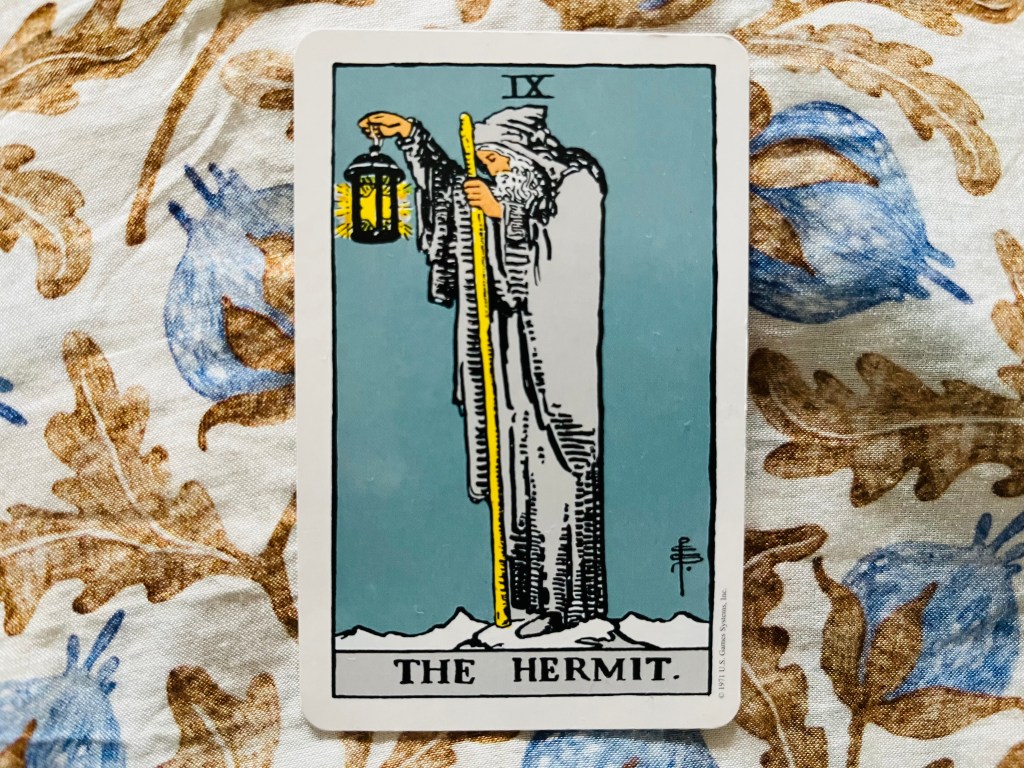
Nel mazzo Rider-Waite, l’Eremita è raffigurato invece, su una montagna, solo, avvolto in un mantello grigio. Nella sua lanterna brilla una stella a sei punte, simbolo dell’unione degli opposti (maschile e femminile, cielo e terra, spirito e materia). È la stella di David, ma anche l’alchimia perfetta del sapere che si trasforma in comprensione.
Nei Tarocchi di Thoth di Aleister Crowley, l’Eremita è più occulto, vicino all’archetipo del Mago ermetico. Porta con sé il serpente della saggezza e un uovo cosmico, simboli della rigenerazione e del potenziale nascosto. Il suo viaggio non è solo spirituale: è iniziatico. Rappresenta il cammino esoterico verso la verità ultima.
La sua energia si ritrova nei grandi saggi della mitologia e della letteratura: Tiresia, cieco ma chiaroveggente; Ulisse, che cerca la conoscenza viaggiando; Gandalf, il mago silenzioso che guida con poche parole e gesti misurati. È anche Saturno, pianeta associato al tempo, alla disciplina, alla profondità dell’anima.
Il numero nove non è casuale: è il compimento di un ciclo, la soglia prima del cambiamento. È l’ultimo passo prima della trasformazione, della Ruota che riparte. È la gestazione, il tempo necessario prima di un nuovo inizio. L’Eremita chiude un ciclo di esperienze e prepara il terreno per la rinascita.
Quando compare in una lettura, questo Arcano non parla mai a voce alta. Suggerisce. Invita. Sottovoce. Può indicare solitudine, sì, ma anche bisogno di ritirarsi per ritrovare sé stessi. È il tempo della meditazione, del diario, dei libri sottolineati a margine, dei cammini nei boschi o delle notti silenziose passate a guardare il cielo.
Nelle relazioni, l’Eremita può significare il bisogno di spazio, di ascolto autentico, di distacco dalle dinamiche superficiali. In ambito professionale, è la figura del mentore, del ricercatore, dell’artigiano solitario che lavora con dedizione e senza clamore. Sul piano spirituale, è il momento in cui il mondo tace e l’anima parla.
È il sapere che non ha bisogno di essere mostrato, ma che cambia tutto ciò che tocca.
The Hermit: the wisdom that does not need to be approved
After the lucid and brave balance of the Force, the Hermit enters with a slow, silent step. Arcana IX is the guardian of inner time. He doesn’t ask for answers, but for better questions. He invites us to be still, to listen, to pause in a world that never stops.
In classic depictions, such as the Tarot of Marseille, the Hermit is an old wanderer with a veiled face or one turned away, walking with a lantern in one hand and a staff in the other. The lantern isn’t meant to light the world, but to illuminate the path within. The staff is not a symbol of weakness, but of guidance: it is the tool of the pilgrim, the seeker of truth.
In the Rider-Waite deck, the Hermit stands atop a mountain, cloaked in gray, alone. Inside his lantern shines a six-pointed star, a symbol of the union of opposites (masculine and feminine, heaven and earth, spirit and matter). It is the Star of David, but also the perfect alchemical blend of knowledge transformed into understanding.
In Aleister Crowley’s Thoth Tarot, the Hermit appears more arcane, closer to the archetype of the hermetic magician. He carries with him the serpent of wisdom and a cosmic egg, symbols of regeneration and hidden potential. His journey is not merely spiritual—it is initiatory. He represents the esoteric path to ultimate truth.
His energy echoes through mythology and literature: Tiresias, blind but far-seeing; Odysseus, the seeker of knowledge through wandering; Gandalf, the quiet guide whose wisdom unfolds in subtle gestures and few words. He is also Saturn, the planet of time, discipline, and soul-deep gravity.
The number nine is not incidental: it marks the completion of a cycle, the threshold before change. It is the moment before transformation, the Wheel’s stillness before its next turn. It represents gestation, the necessary pause before a new beginning. The Hermit closes a circle of experience and prepares the ground for rebirth.
When he appears in a reading, this Arcana never speaks loudly. He hints. Suggests. Whispering. He may indicate solitude, yes, but also the need to retreat in order to find oneself again. It is the time of meditation, of journals, of underlined pages, of long walks in the woods or quiet nights spent watching the stars.
In relationships, the Hermit can mean the need for space, for deep listening, for stepping away from superficial dynamics. In work, he is the mentor, the researcher, the solitary artisan who creates with dedication and humility. Spiritually, he marks the moment when the world falls silent, and the soul begins to speak. He is the kind of wisdom that does not need to be displayed—yet changes everything it touches.
ARTICLE & TRANSLATION
Antonella Buttazzo
@antonella_buttazzo
 Pigiama Magazine ☾
2 Comments